

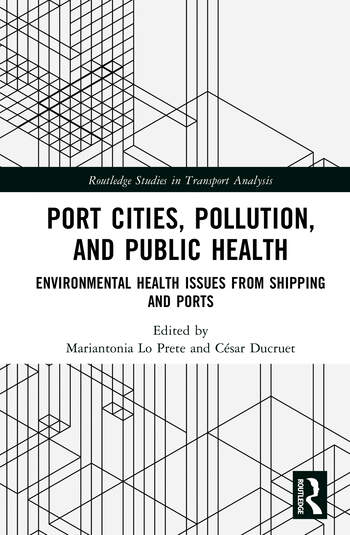
Port cities of the world are critical nodes for international trade and socio-economic development. Yet they bear several costs, of which congestion and pollution, which affect the local environment and population. In certain places, living near the port –together with related industrial and logistical activities –is synonym of adverse health outcomes, resulting in several diseases and above-average unplanned hospital admissions and mortality. Decades of port-city physical separation have not eliminated such issues, since deep-water facilities, even outside urban cores, impact local populations and reach port and non-port cities through extensive trucking flows. Specific traffic, like cruise, keep operating within dense urban environments.
This book is one of the first dedicated volumes on such matters, with contributions from scholars in several continents (Europe, Asia, the Americas, Africa, and Oceania). It is highly interdisciplinary, covering geography, history, economics, management sciences, regional science, sociology, public and comparative law, physics, energy and industrial engineering, urban and spatial planning, epidemiology, architecture, biology, and environmental sciences. This volume offers an overview of current environmental and health issues in port cities. It starts by presenting the mitigation and perception of port pollution. Next, it examines the health impacts of ports in a historical perspective and reviews and synthesizes the variety of existing approaches to measure the health impacts of ports and shipping. Finally, it proposes a reflection on a multi-level governance and policies.
This book is a comprehensive resource for a wide readership, including academics and upper-level students interested in maritime transport, port management and sustainability, as well as those in public management, planning and governance.
 Veuillez patienter ...